
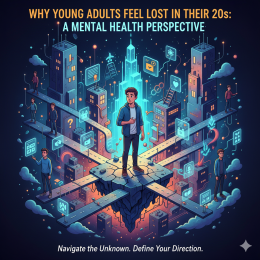
Why Young Adults Feel Lost in Their 20s: A Mental Health Perspective
2026-01-16 18:11:08The twenties are often painted as the most exciting phase of life. A decade meant for exploration, ambition, love, and self-discovery. It is supposed to be the time when dreams take shape and life begins to make sense. From the outside, it looks vibrant and full of promise. Yet for many young adults, the inner experience tells a very different story.
Behind the smiles and achievements lies confusion, emotional exhaustion, self-doubt, and a quiet but persistent fear of falling behind. Feeling lost in your 20s is far more common than society is willing to admit, and from a mental health perspective, it is not only understandable-it is expected.
At CIIMHANS, we often meet young adults who struggle to explain what feels wrong. They are doing everything they are “supposed” to do-studying, working, meeting responsibilities, moving forward on paper-yet they carry a constant sense of uncertainty. This feeling of being stuck without a clear reason can be deeply unsettling. However, it is not a sign of weakness or failure. More often, it reflects a period of transition, internal change, and emotional pressure that has gone unspoken for too long.
One of the biggest contributors to this sense of being lost is the unrealistic expectation to have life figured out early. There is an unspoken narrative that by your 20s, you should know who you are, what you want, and where you are going. When real life fails to align with this timeline, self-doubt quietly sets in. People begin comparing their internal confusion with others’ external achievements, assuming everyone else feels confident and certain while they are somehow falling behind. This silent gap between expectation and reality slowly fuels anxiety.
From a psychological standpoint, the twenties are a critical phase of identity formation. The brain is still developing, particularly the regions responsible for emotional regulation, long-term planning, and decision-making. Uncertainty during this stage is not abnormal-it is part of the process. Young adults are questioning long-held beliefs, redefining values, and trying to understand what kind of life feels meaningful to them. Feeling lost during this search does not indicate a lack of direction; it often signals a deep desire for authenticity.
Career-related pressure further intensifies this emotional struggle. Choosing a career can feel like choosing an entire future, and the fear of making the “wrong” decision can become overwhelming. Many young adults feel caught between personal interests and practical demands, between passion and financial security, or between their own aspirations and family expectations. When progress feels slow or unclear, the mind interprets it as failure-even when growth is quietly unfolding beneath the surface.
Social media has added another layer to this complexity. Online spaces are filled with carefully curated versions of success-promotions, relationships, travel, milestones. What remains largely invisible are moments of doubt, emotional burnout, and uncertainty. Over time, this creates the illusion that everyone else is moving forward with confidence while you are standing still. Constant comparison erodes self-worth and deepens feelings of inadequacy, often without conscious awareness.
Another often overlooked aspect of feeling lost in the 20s is emotional loneliness. As friendships evolve, routines change, and life transitions occur, support systems may no longer feel as secure as they once did. Even when surrounded by people, many young adults feel misunderstood or unable to openly express their inner struggles. Emotional loneliness is not always about being alone; it is about feeling unseen. When emotions remain unexpressed for too long, they can surface as overthinking, irritability, numbness, or a persistent sense of emptiness.
At CIIMHANS, we observe that many mental health challenges in young adults do not emerge suddenly. They develop gradually through unprocessed emotions, repeated self-criticism, and prolonged stress. Feeling lost becomes a concern when it is accompanied by persistent sadness, anxiety, lack of motivation, or hopelessness. These experiences are not personal failures; they are signals that the mind needs care, attention, and support.
Therapy is often misunderstood as something meant only for severe crises. In reality, it can be a space for clarity, reflection, and emotional grounding. For young adults, therapy provides a safe environment to explore identity, process pressure, and understand internal conflicts without judgment. It helps individuals learn how to sit with uncertainty without being overwhelmed by it.
Feeling lost in your 20s does not mean you are falling behind in life. It often means you are in the process of becoming more aligned with who you truly are. Growth is rarely comfortable, and clarity does not arrive all at once. It unfolds gradually, through experience, self-reflection, and self-compassion.
At CIIMHANS, we believe mental health is not about having all the answers. It is about learning how to move forward with awareness, patience, and support. If you are in your 20s and feel lost, know that you are not alone. You are not broken. You are evolving-and that journey deserves understanding, not judgment.